
If your 7th grader's math homework suddenly takes longer, or a once-confident kid now says "I don't get it," you are right to pay attention. Seventh grade math looks like a small step up, but it quietly introduces many of the rules Algebra 1 is built on. Gaps that start this year tend to grow, so catching them early saves a lot of stress later.
Signs your 7th grader needs pre-algebra help include frequent sign errors with negative numbers, trouble solving one-step and two-step equations, and guessing on proportion problems. If you see two or more of these, start targeted practice this month, because 7th grade skills are the foundation for Algebra 1.
Here are the specific warning signs to look for, why they matter so much for next year, and a four-week plan to act on them.
Warning sign 1: Integer rules are not automatic
Operations with positive and negative numbers (integers) are a core skill of 7th grade. They show up in nearly every problem afterward.
What to look for
- Answers that are right except for the sign: -7 when the answer is 7.
- Confusing subtraction and negative signs, such as treating 5 - (-3) as 2 instead of 8.
- Reciting "two negatives make a positive" and applying it to addition, so -4 + -6 becomes 10.
- Slowing down a lot or reaching for a calculator for problems like -12 divided by 3.
Try this together
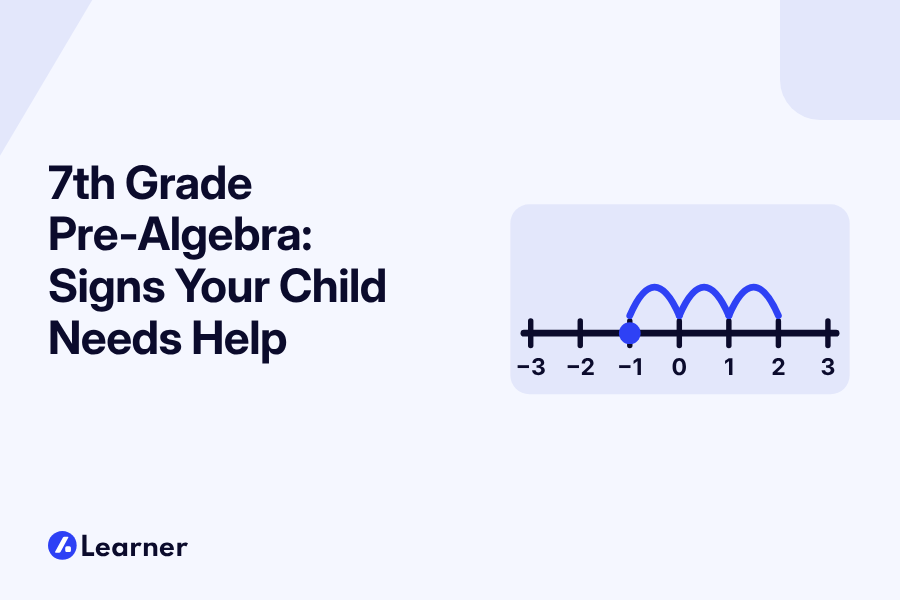
Ask your child to solve -8 + 5, -8 - 5, -8 × -5, and 8 - (-5). The answers are -3, -13, 40, and 13. If they miss more than one or cannot explain why, integer rules need work. A number line helps with adding and subtracting. For multiplying, a simple pattern shows why a negative times a negative is positive. Count the first number down by one and watch the answers: 3 × -2 = -6, 2 × -2 = -4, 1 × -2 = -2, 0 × -2 = 0. Each answer goes up by 2, so the next one, -1 × -2, has to be 2.
Warning sign 2: Equations are solved by guessing
Seventh graders move from finding missing numbers to solving equations step by step. Some kids can guess their way through x + 4 = 10, but that strategy falls apart on 3x - 7 = 11 or 2(x + 3) = 14.
What to look for
- Your child writes only the answer and cannot show the steps.
- They do the same operation to only one side of the equation.
- They undo steps in the wrong order, dividing before subtracting in 3x - 7 = 11.
- Equations with negatives or fractions stop them completely.
Try this together
Solve 3x - 7 = 11. Step one: add 7 to both sides, so 3x = 18. Step two: divide both sides by 3, so x = 6. Check by substituting: 3(6) - 7 = 18 - 7 = 11. Ask your child to say each step out loud and explain why that step comes first. If they can do the check without prompting, that is a good sign.
Warning sign 3: Proportional relationships do not make sense
Seventh grade extends 6th grade ratio work into proportional relationships: recognizing them in tables and graphs, finding the constant of proportionality, and solving percent problems like tax, tips, and discounts.
What to look for
- Your child cannot tell whether a table shows a proportional relationship.
- They set up proportions with the numbers in the wrong places.
- Percent problems (sale prices, tips) feel random to them.
- They do not connect a straight line through the origin with a constant rate.
Try this together
Show your child a table: 2 hours, 30 miles; 4 hours, 60 miles; 5 hours, 75 miles. Is it proportional? Yes, because miles divided by hours is always 15. That 15 is the constant of proportionality, and next year it becomes slope.
Why 7th grade sets up Algebra 1
Algebra 1 assumes integer operations, equation solving, and proportional reasoning are automatic. A typical Algebra 1 problem, like solving -2(x - 4) = 3x + 18, combines integer rules, the distributive property, and multi-step equation solving in a single line. A student who is still unsure whether -2 × -4 is positive or negative will get lost in the details and miss the new ideas being taught.
Proportional relationships lead directly into slope and linear functions, which make up a large part of Algebra 1. That is why a shaky 7th grade year often shows up as a hard 8th or 9th grade year. Our guide to helping a 9th grader who is falling behind in Algebra 1 shows where these gaps tend to surface.
What to do this month
Before you start, try one more check, especially if homework comes back mostly correct but quiz and test scores keep dropping. That pattern often means your child can follow a worked example or get help from notes, but cannot yet do the problems alone. Ask your child to solve three homework problems with the notebook closed. What happens then tells you more than the grade on the worksheet.
If you saw two or more warning signs, here is a four-week plan with about 15 to 20 minutes a day, four days a week. Spend extra time on the weeks that match the signs you saw, and shorten the others. For practice problems, use the textbook's chapter reviews or sets the teacher recommends.
- Week 1, integers: number line practice for adding and subtracting, pattern work for multiplying and dividing. Finish with a mixed set of 20 integer problems.
- Week 2, one-step and two-step equations: solve with written steps every time, and check each answer by substituting. Add negatives by the end of the week.
- Week 3, proportional relationships: tables, unit rates, and real percent problems (a sale price, a restaurant tip). Ask your child to check whether each table is proportional.
- Week 4, mixed review: problems from all three areas, mixed together, so your child has to decide which skill each one needs.
At the end of the month, compare your child's work on the quick checks above with how they did at the start. If the same errors keep showing up, that is a signal to get outside help.
Example: an equations test that's really an integer problem
Say your daughter finishes her homework every night but just scored poorly on an equations test. When you watch her solve 4x + 9 = 1, she knows to subtract 9 from both sides but writes 4x = 8 instead of -8. Her equation steps are fine. The real gap is integer subtraction. A week focused on integers would likely fix more of her test errors than another week of equations. For a broader way to think about whether outside help makes sense, see does my child need a tutor.
Getting pre-algebra help that sticks
A tutor can find which of these skills is behind the trouble and build it up while your child keeps pace with class. With Learner's 1-on-1 online 7th grade math tutoring, an Academic Advisor learns about your child's needs and matches you with a tutor who fits. When you're ready, get matched with a 7th grade math tutor.
Frequently Asked Questions
What is taught in 7th grade pre-algebra?
Many 7th grade math programs cover operations with positive and negative numbers, writing and simplifying expressions, solving one-step and two-step equations and inequalities, proportional relationships, percents, and some geometry and probability. Many programs label this course pre-algebra, while others call it 7th grade math or Math 7. The exact scope depends on your state standards and curriculum, so check your child's syllabus or textbook table of contents.
How do I know if my child is ready for Algebra 1?
A child ready for Algebra 1 can add, subtract, multiply, and divide negative numbers accurately, solve two-step equations and explain the steps, work with fractions and decimals without a calculator, and recognize proportional relationships in tables and graphs. If several of those are shaky at the end of 7th or 8th grade, spending time on them before Algebra 1 usually pays off.
Why does my child understand pre-algebra in class but fail the tests?
This often happens when a student can follow along with an example but has not practiced enough on their own to do problems without a model. It can also signal careless errors with negative signs or fractions that add up on a test. Ask your child to solve a few problems from the homework without notes and explain them out loud. That shows where the understanding breaks down.
Can I help with 7th grade math if I do not remember it?
Yes. You do not need to reteach the content. You can ask your child to explain each step, check answers using the back of the book or by substituting the answer back into the equation, and watch for the warning signs in this article. Asking good questions often helps more than giving explanations. If you need more support, a teacher or tutor can fill in the instruction.