
If your teen is good at math and still struggling in AP® Physics 1, they are in good company, and so are you. The course has a reputation as one of the tougher APs, and low early grades are common. The math is manageable; the concepts are what take work.
To help your teen get through AP Physics 1, focus on concepts over formulas. The course is algebra-based but asks students to reason about why things move. Teach a consistent free-body diagram routine, have your teen practice explaining answers in words, and set a weekly structure of short, mixed problem sessions instead of cramming before tests.
Why AP Physics 1 feels harder than the math suggests
AP Physics 1 uses algebra and some basic trigonometry, not calculus. Many students expect that to make it easy. The challenge is that the course asks students to understand physical ideas well enough to predict and explain what happens, often without plugging numbers into a formula at all.
Common sources of frustration:
- Formula hunting. Students search for the equation with the right letters instead of thinking about what is happening. This works on easy homework and fails on tests.
- Everyday intuition fights physics. Many people feel that a moving object needs a force to keep moving. Physics says otherwise, and unlearning that takes time.
- Questions without numbers. Some questions ask what happens to a quantity if something doubles, or ask students to compare two situations. Students who rely on calculation feel lost.
- Written explanations. Free-response questions ask students to justify answers in writing, connect equations to graphs and diagrams, and design experiments.
The course covers motion (kinematics), forces and Newton's laws, energy, momentum, rotation, oscillations and fluids. The exam is hybrid digital: students answer multiple-choice questions in College Board's Bluebook app and handwrite their free-response answers. The 2027 exam is on May 5, 2027. For details, see College Board's AP Physics 1 exam page.
A free-body diagram routine for force problems
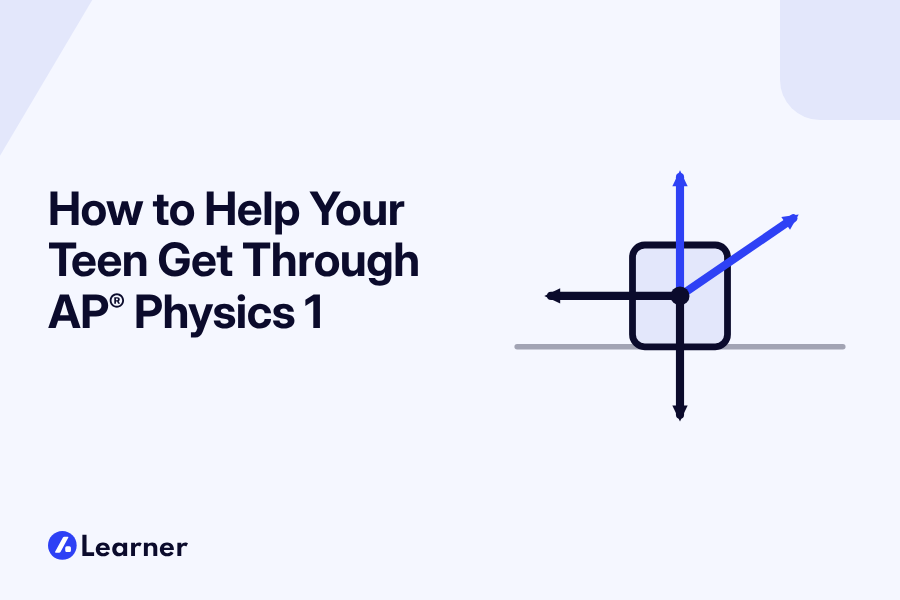
Forces show up throughout the course, and a clean free-body diagram is one of the most useful habits your teen can build. The same routine works on every force problem, even easy ones. Here is what a correct diagram includes, so you can check your teen's work without knowing physics:
- One object. Each diagram shows a single object, drawn as a dot or a simple box.
- A force for everything touching it. Every surface, rope or hand in contact creates a force: normal force, friction, tension or an applied push or pull.
- The non-contact forces. In AP Physics 1, this is usually gravity (weight), pointing straight down.
- Arrows pointing outward from the object. Each arrow points in the direction of the force, with longer arrows for larger forces when the relative size is known.
- A label on every arrow saying what exerts it and on what, for example "force of rope on box."
- No extra forces. There is no "force of motion" or "force of velocity." If nothing is pushing or pulling, there is no arrow.
- Axes that fit the problem. One axis lines up with the direction of acceleration when possible. On a ramp, the axes tilt to match the slope.
- Newton's second law for each axis. The sum of forces equals mass times acceleration, written as one equation for each direction.
For example, say your daughter is working on a box pulled across a floor by a rope at an angle. Her diagram should have four arrows: weight down, normal force up, friction opposite the motion, and tension along the rope. If she draws a fifth arrow labeled "motion," the checklist catches it at item 6.
Remind your teen that the equations come after the diagram, not before.
How to explain reasoning in words
AP Physics 1 free-response questions often ask students to "justify," "explain" or "describe" their reasoning. Many students write one vague sentence and lose points. A simple structure helps.
The claim, principle, connection structure
- Claim: State the answer directly. "Both blocks reach the bottom of their ramps with the same speed."
- Principle: Name the physics principle that applies. "Energy is conserved because friction is negligible."
- Connection: Link the principle to the specific situation. "Both blocks start from rest at the same height, so each loses the same gravitational potential energy per kilogram on the way down. That energy becomes kinetic energy, so both end with the same kinetic energy per kilogram and the same speed, no matter how steep each ramp is."
Have your teen practice this on two or three problems a week, including ones they already solved with numbers. Saying the explanation out loud before writing it often makes the written version clearer.
Watch for these weak phrases
- "Because of physics" or "because of gravity" with nothing after it
- "It just has more force"
- Restating the question as the answer
Each of these signals a missing principle or connection.
A weekly practice structure for AP Physics 1
Physics skills fade fast without practice. A steady weekly plan of about 30 to 40 minutes a day, four or five days a week, works better than long sessions before tests.
- Day 1: Your teen reviews class notes, rewrites the key ideas in plain language and draws the main diagrams from memory.
- Day 2: Homework problems with a full free-body diagram or energy bar chart for each.
- Day 3: Three conceptual questions with no numbers, answered using claim, principle, connection.
- Day 4: One released free-response question, then a comparison with the published scoring guidelines.
- Day 5 (optional): Mixed review of two earlier units. Physics builds on itself, so older topics come back.
Strong algebra and right-triangle trig make all of this smoother. If your teen keeps losing points to algebra slips or confusion with sine and cosine on angled forces, a few sessions with a trigonometry tutor can help.
How parents can support without knowing physics
- Ask your teen to explain one problem to you each week. If they can teach it, they understand it.
- Check that every force problem starts with a diagram.
- Encourage questions in class or office hours early in each unit.
- Keep the tone calm. Low early grades are common in AP Physics 1 while students adjust to concept-heavy tests.
If test grades stay low after two full units despite steady practice, look at where points are lost. Mostly algebra and trig slips point to a math gap. Mostly blank or vague explanations point to a concept gap. Each calls for a different fix, so sort the missed questions before deciding what kind of help your teen needs.
Get AP Physics 1 support from Learner
A tutor can watch your teen set up problems, correct habits like formula hunting and coach the written explanations that free-response questions reward. A Learner Academic Advisor learns about your teen's needs and matches you with a tutor who fits. Explore our physics tutoring, then get matched with a physics tutor. We offer a 100% risk-free satisfaction guarantee.
Frequently Asked Questions
Is AP Physics 1 hard if my teen is good at math?
Being good at math helps, but it does not guarantee an easy year. AP Physics 1 uses algebra and basic trig, and the harder part is understanding concepts well enough to predict and explain physical behavior. Students who rely on finding the right formula often struggle on conceptual and free-response questions. Building diagram and explanation habits early makes a big difference.
Does my teen need calculus for AP Physics 1?
No. AP Physics 1 is algebra-based and uses algebra and basic trigonometry, such as sine and cosine for angled forces. Calculus-based physics is covered in the AP Physics C courses. Students should be comfortable solving equations, working with variables and using right-triangle trig before starting AP Physics 1.
How should my teen study for AP Physics 1 tests?
Encourage understanding over memorizing. Have your teen redo homework problems from scratch with full diagrams, practice conceptual questions that have no numbers, and explain answers out loud using a claim, principle and connection. Mixing in problems from earlier units helps because physics builds on itself. Short daily practice through the unit works better than cramming the night before.
What is a free-body diagram and why does it matter?
A free-body diagram is a simple sketch of one object with arrows showing every force acting on it, such as gravity, normal force, friction and tension. It matters because it turns a word problem into a clear picture of what is pushing or pulling, which makes it easier to apply Newton's laws and avoid adding forces that do not exist.
Should my teen take AP Physics 1 or regular physics?
It depends on their math comfort, schedule and goals. Students with solid algebra and some trig who enjoy reasoning through problems often do well in AP Physics 1. Students who are already overloaded or who struggled in Algebra 2 may get more out of regular physics. Ask the science teacher what skills they see as most important for success.