
Schools often ask parents to weigh in on 8th grade Algebra 1 in the spring of 7th grade, often with little explanation, and it is natural to worry about making the wrong call. The choice matters, but it is less permanent than it feels.
Your 8th grader should take Algebra 1 if they are fluent with fractions, integers, ratios and simple expressions, handle 7th grade math without heavy support, and want the challenge. If those skills are shaky, a strong pre-algebra year is often the better choice, and students who take Algebra 1 in 9th grade can still reach calculus.
What 8th grade Algebra 1 means
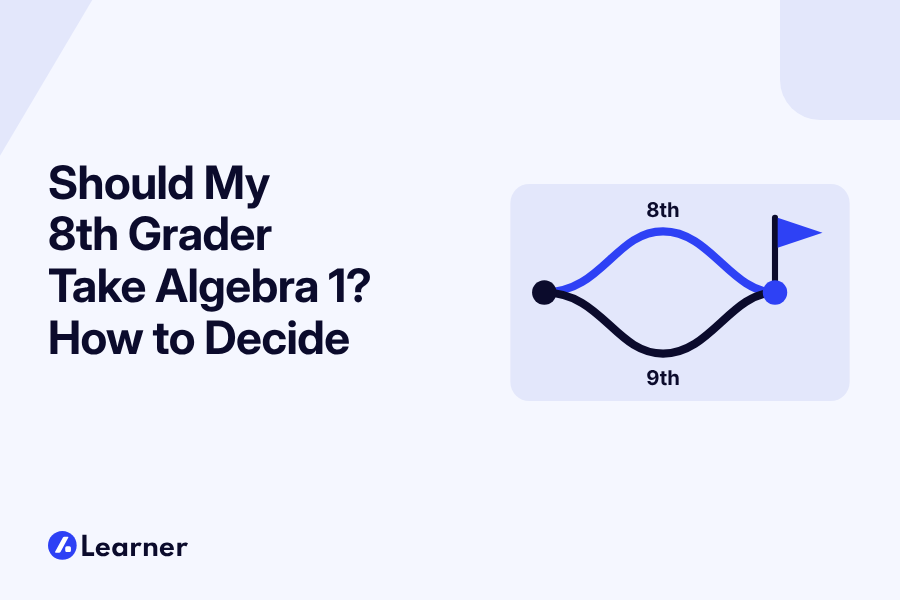
In many schools, 8th grade math is a pre-algebra or "Math 8" course, and Algebra 1 is the standard 9th grade class. Taking Algebra 1 in 8th grade moves your child one year ahead in the high school math sequence. Some schools call this an accelerated or honors track.
Algebra 1 in 8th grade is usually the same course content taught to 9th graders, sometimes at a slightly faster pace. It often counts toward high school math credit, depending on your district. Ask your school how the grade is recorded, because in some districts it appears on the high school transcript.
Readiness checklist: is your child ready for Algebra 1?
Ask your child to work through these without a calculator. If they can do most items comfortably and explain why, they are likely ready. If several feel hard, that tells you where to build skills first. Our guide to signs your 7th grader needs pre-algebra help has quick checks and a four-week plan for the most common gaps.
Fractions
- Add and subtract fractions with unlike denominators (2/3 + 3/4 = 17/12, or 1 5/12)
- Multiply and divide fractions and mixed numbers without guessing which rule to use
- Simplify a fraction and convert between fractions and decimals
Integers
- Add, subtract, multiply and divide negative numbers quickly and accurately
- Explain why -4 - (-9) equals 5
- Follow order of operations with negatives and exponents
Ratios and proportions
- Set up and solve a proportion from a word problem
- Find a unit rate (miles per hour, cost per item)
- Describe a constant rate of change in a table
Expressions and early equations
- Translate "five less than twice a number" into 2n - 5
- Distribute and combine like terms, such as 3(x + 4) - 2x = x + 12
- Solve two-step equations like 4x - 7 = 13 (x = 5) and check the answer (4 × 5 - 7 = 13)
Habits
- Shows work in an organized way
- Keeps trying when a problem does not click right away
- Completes homework without daily reminders most of the time
Decision rule: If your child checks at least three of the four skill groups fully and the habits line up, Algebra 1 in 8th grade is a reasonable choice. If two or more skill groups are weak, a pre-algebra year, plus targeted practice, is often the safer path.
How the choice affects the path to calculus
The main reason families care about this decision is how it plays out four or five years later. Here is a common sequence, though every school differs.
- Algebra 1 in 8th grade: Geometry in 9th, Algebra 2 in 10th, Pre-Calculus in 11th, Calculus (often AP® Calculus) in 12th.
- Algebra 1 in 9th grade: Geometry in 10th, Algebra 2 in 11th, Pre-Calculus in 12th. Calculus would come in college unless the student accelerates later.
Students on the second path still have options. Some take geometry over the summer, double up on math in one year, or take a community college course. Many schools offer an "Algebra 2 with Pre-Calculus" or similar compressed course. These options vary, so ask your school counselor what is available.
It also helps to be honest about who needs calculus in high school. Students aiming at engineering, physics, computer science or other math-heavy majors often benefit from it. Many other students are well served by Pre-Calculus or statistics senior year. A strong Algebra 1 grade in 9th grade can open more doors than a weak one in 8th.
For example, say your daughter breezed through 7th grade math but freezes on fraction word problems. She might do fine in 8th grade Algebra 1 with a summer of fraction practice. If she also struggles with negative numbers and needs help on most homework, waiting a year will likely give her a better high school start.
Questions to ask the school before you decide
- What placement data are you using (test scores, grades, teacher recommendation)?
- Does 8th grade Algebra 1 count for high school credit, and is the grade on the transcript?
- If my child struggles, can they move back to Math 8 partway through the year, and until when?
- What does the high school math sequence look like from each starting point?
- Is there a summer bridge course or a way to accelerate later?
What to do if your child is placed in Algebra 1 and struggles
Struggle in the first few weeks is normal. Algebra 1 asks students to use every earlier skill at once. The question is whether the struggle is shrinking or growing by the first progress report.
- Find the gap. Much of the early trouble in Algebra 1 traces back to the checklist above: integers, fractions or distributing. Look at missed quiz problems and note which skill broke down.
- Repair it in short doses. Fifteen to twenty minutes a day on the weak skill, four or five days a week, for two to three weeks.
- Talk with the teacher early. Ask what they are seeing in class and whether test corrections or retakes are an option.
- Know the move-back deadline. If grades are still falling after a month of steady effort, ask about switching courses before the school's cutoff. Moving back is a placement adjustment and nothing to be ashamed of.
Our guide to helping a student who is falling behind in Algebra 1 walks through a two-week catch-up plan.
How Learner supports 8th grade math students
Whether your child is preparing for Algebra 1 or catching up in it, 1-on-1 help can make the year feel manageable. With Learner's 1-on-1 online 8th grade math tutoring, an Academic Advisor learns about your child's needs and matches you with a tutor who fits. When you're ready, get matched with a math tutor. Your first session is commitment-free.
Frequently Asked Questions
Is Algebra 1 in 8th grade considered advanced?
In many U.S. schools, yes. The standard path places Algebra 1 in 9th grade, so taking it in 8th grade puts a student one year ahead. Placement practices vary widely between districts, so what counts as advanced depends on your school. Ask how many students typically take it and how placement works.
Can my child skip Algebra 1 in 8th grade and still take calculus?
Yes, though it usually takes planning. Common routes include a summer geometry course, doubling up on math in one year, a compressed Algebra 2 and Pre-Calculus course, or a dual enrollment class. Availability depends on the school. Talk with a counselor in 9th grade so the plan fits around other classes.
What grade does my child need in 7th grade math to take Algebra 1?
There is no universal cutoff. Schools usually look at a combination of grades, placement or state test results, and teacher recommendations. A high grade helps, but skills matter more. A student who earned an A with heavy support may be less ready than one with a B who works independently and has solid fraction and integer skills.
What happens if my 8th grader fails Algebra 1?
Policies vary. Many schools let students retake Algebra 1 in 9th grade, and some replace the 8th grade grade on the transcript or exclude it from the high school GPA. Ask your school how they handle it. A retake can go much better because the student has seen the material once and can focus on the weak spots.
How can my child get ready for Algebra 1 over the summer?
Focus on fractions, negative numbers, ratios and simplifying expressions, since those skills appear in nearly every Algebra 1 unit. Twenty minutes of practice a few days a week is enough for many students. Mix in two-step equations near the end of summer. Keeping practice short and regular works better than cramming the week before school starts.